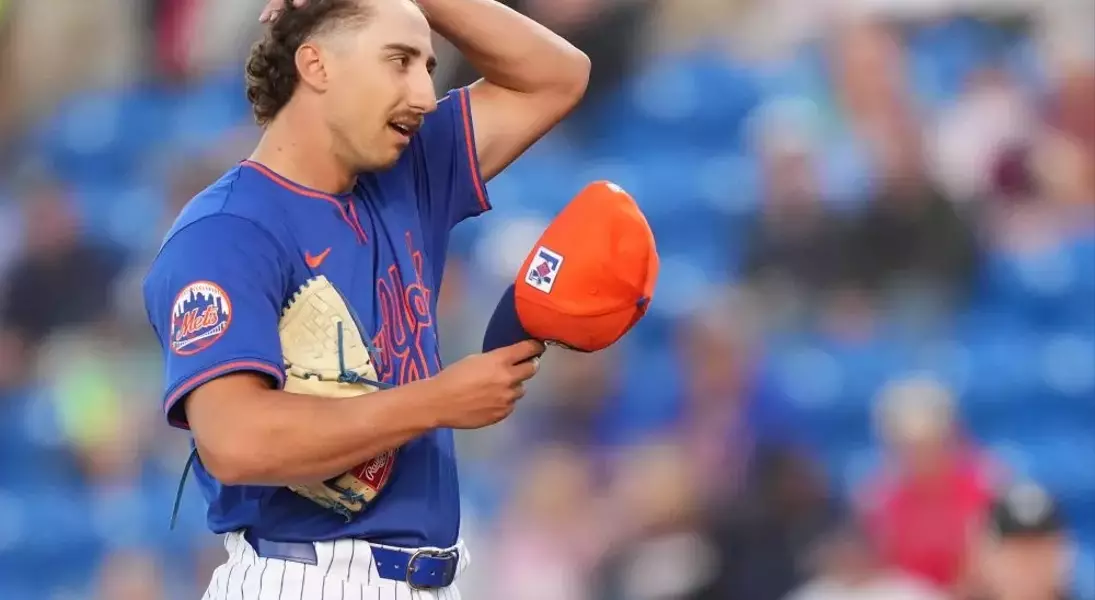
Brandon Sproat, a standout from the University of Florida, was initially drafted by the Mets in 2022 but did not sign, opting to return to college. The Mets re-drafted him in the second round in 2023, securing his talent. Despite his high ranking (39th on the Top-101 for 2025 prospects) and strong performance in the minor leagues, he faced challenges in Triple-A for much of the current year, with an earned run average nearing six until a key start on June 22. Since then, Sproat has implemented significant changes to his pitching approach, resulting in a drastically improved ERA of 2.44 and a 21 K-BB%, though his strikeout numbers have varied between appearances.
A critical adjustment for Sproat was enhancing his fastball's intensity, elevating its average velocity to approximately 97 mph, a crucial benchmark for fastball effectiveness. This was particularly important given his fastball's less-than-ideal shape, characterized by low spin rates and average movement that didn't consistently translate into effective mound presence. While this pitch has proven effective in Triple-A, maintaining its high velocity will be key for success in the major leagues. He also introduced a sinker last offseason to counter fastballs, inducing ground balls at a 74% rate against right-handed batters. However, this addition negatively impacted his changeup against left-handers, as its motion closely resembled the fastball. This led to a second major adjustment: refining his pitch mix against left-handed batters by significantly reducing sinker usage (less than 5% in August), which allowed his changeup to achieve a more distinct vertical separation from his fastball, while retaining its 90 mph speed. Consequently, his whiff and chase rates against left-handers have both surged by 17 percentage points. Additionally, Sproat increased the use of his curveball, throwing it harder, now averaging 81 mph, which has led to a third of swings resulting in misses since the change in intent. His previous 80-degree slider also transformed into a true 'slutter,' now boasting five inches of rise and an average speed exceeding 90 mph.
Against right-handed batters, Sproat continues to rely heavily on his fastball, utilizing a balanced mix of four-seamers and sinkers to keep hitters off balance and achieve favorable outcomes. While his sweeper's shape can be inconsistent, it averages 14 inches of glove-side movement at around 85 mph, suggesting potential for more east-west deception. His changeup and curveball have also performed well against same-handed hitters, though integrating the changeup with the sinker at a higher rate might pose challenges. Sproat's strike rate is near the MLB average, but his walk rate remains high against left-handers, likely due to his tendency to induce chases rather than throwing strikes over the plate. This, combined with a tendency to lose velocity deeper into games (though still around 95 mph, his pitch shape deteriorates), hints at a potential future in a relief role. However, his current arsenal and recent Triple-A performance suggest he remains a viable starting option, and he is now set to join his fellow prospects in the Mets' revitalized rotation.
Brandon Sproat's journey serves as a powerful testament to the impact of persistent dedication and strategic adaptation in achieving one's aspirations. His willingness to analyze his performance, identify areas for improvement, and implement significant changes to his pitching mechanics and strategy has been instrumental in his recent turnaround. This proactive approach not only highlights his innate talent but also underscores a commendable commitment to growth and excellence. Sproat's narrative is a reminder that success often stems from an unwavering belief in one's potential and the courage to evolve in the face of adversity, ultimately leading to a more refined and formidable presence in the competitive arena of professional baseball. His story inspires individuals to embrace challenges as opportunities for self-improvement and to strive for continuous development in their chosen paths.