The global financial landscape is currently a complex interplay of monetary policy decisions, crucial economic indicators, and evolving geopolitical narratives. As market participants await the highly influential US Consumer Price Index (CPI) report, which is set to shape investor sentiment and currency movements, other significant developments are also unfolding. The Reserve Bank of Australia (RBA) recently enacted a widely anticipated interest rate reduction, underscoring its proactive stance on managing inflation and navigating an uncertain economic outlook. Simultaneously, internal economic data from the US offers a nuanced view of consumer health, highlighting potential vulnerabilities within lower-income segments. These factors, alongside ongoing international relations and shifts in business confidence in Europe and the US, collectively paint a dynamic picture for global markets.
The eagerly awaited US CPI data, scheduled for release, is poised to significantly impact market dynamics. Current projections indicate a modest rise of 0.2% in the headline CPI compared to the previous month's 0.3%, while the core CPI is expected to increase by 0.3% from 0.2%. On a year-over-year basis, the headline figure is forecast at 2.8%, with the core measure potentially reaching 3.0%, a slight uptick from 2.9%. Analysts are closely monitoring goods inflation, as any surge could signal the effects of trade tariffs on consumer prices for items such as furniture, apparel, and household appliances. However, it is crucial to note that services constitute over 60% of the CPI, with housing and rental costs (primarily shelter) accounting for a substantial 32-34%, and owner's equivalent rent alone representing approximately 22%. Healthcare services contribute about 7%, while core goods, excluding food and energy, make up around 20%, with new and used vehicles comprising roughly 3.5% and 4% respectively. This detailed breakdown reveals the multifaceted nature of inflationary pressures in the US economy.
In other significant economic news, the Reserve Bank of Australia's decision to cut interest rates by 25 basis points to 3.60% aligns with market expectations, driven by moderating inflation and an uncertain economic outlook. This unanimous decision emphasizes the central bank's commitment to price stability and full employment. The RBA anticipates inflation to gradually move towards its 2-3% target range, and while labor market conditions have shown a slight easing, they remain comparatively tight. The bank has also acknowledged potential risks stemming from US trade tariffs and broader global policy shifts, along with the inherent delays in the impact of previous policy adjustments. In its quarterly economic projections, the RBA forecasts core inflation to hover around 2.5% through 2027, with GDP growth slowing to approximately 2.0% and unemployment stabilizing near 4.3%. Long-term productivity growth estimates have been revised downward to 0.7%, and both inflation and GDP forecasts have been marginally trimmed. The RBA's assessment suggests a balanced supply and demand scenario through 2027, stable labor market conditions, and minimal disruption from global trade uncertainties thus far.
Insights from Bank of America's July Consumer Checkpoint report highlight a rebound in household spending, with total credit and debit card expenditures per household rising by 1.8% year-over-year, marking the fastest growth since January. Seasonally adjusted monthly spending also saw an increase of 0.6%. Despite this overall positive trend, a notable divergence has emerged in wage and spending growth between lower-income households and other demographic groups. Lower-income households experienced a slowdown in after-tax wage growth to just 1.3% year-over-year in July, while their higher-income counterparts saw an acceleration to 3.2%. Although consumers generally maintain sound financial health, with elevated savings and continued access to credit, the data suggests initial signs of financial strain are becoming apparent among lower-income populations. Concurrently, international relations remain a point of interest, with a planned meeting between former President Trump and Russian President Putin in Alaska on August 15, 2025, reportedly focusing on peace in Ukraine, despite Russia's ongoing military preparations that suggest otherwise. This discrepancy raises questions about the true intent and potential outcomes of such high-level diplomatic engagements.
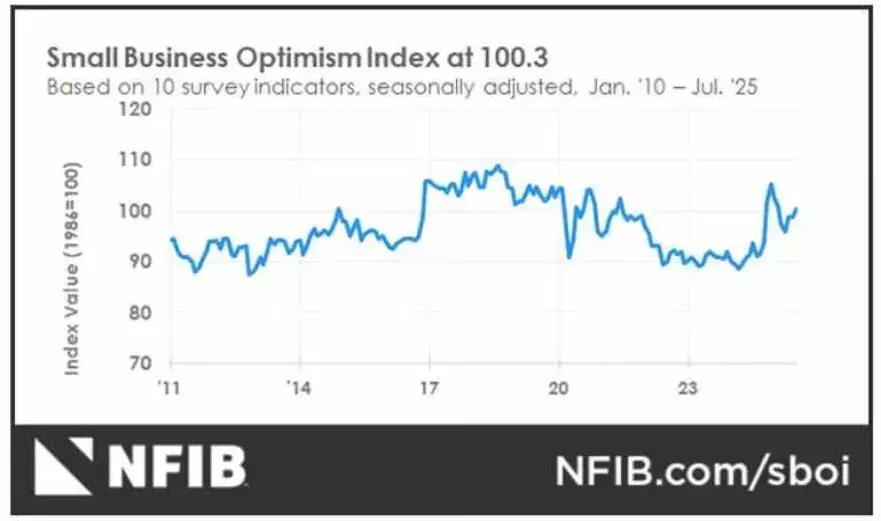
Further economic indicators provide a mixed global outlook. In Germany, the August ZEW survey reflected a significant decline in economic sentiment, with current conditions dropping to -68.6 (below expectations) and the outlook falling to 34.7 (also below forecasts). This downturn is largely attributed to market disappointment regarding the US-EU trade agreement, with chemical and pharmaceutical sectors particularly affected. Conversely, the US July NFIB small business optimism index showed an improvement, reaching 100.3 (above expectations), driven by more positive assessments of business conditions and expansion prospects. However, the Uncertainty Index notably increased by eight points to 97, and concerns over labor quality have escalated, becoming the leading issue for small businesses. Despite these uncertainties, the chief economist at NFIB expressed optimism, anticipating greater clarity in the coming months from permanent tax deductions and final trade policies. In financial markets, US stocks are showing minimal movement ahead of the CPI release, with marginal gains across the Dow, S&P, and NASDAQ. Treasury yields are also slightly higher, reflecting the cautious market sentiment ahead of key economic data releases.
The intricate tapestry of global economic factors, including impending inflation data, central bank policy adjustments, consumer spending trends, and geopolitical tensions, continues to shape investor decisions. The upcoming US CPI report and its potential implications for monetary policy will be closely watched, as will the ongoing responses of various economies to inflationary pressures and the evolving geopolitical landscape.