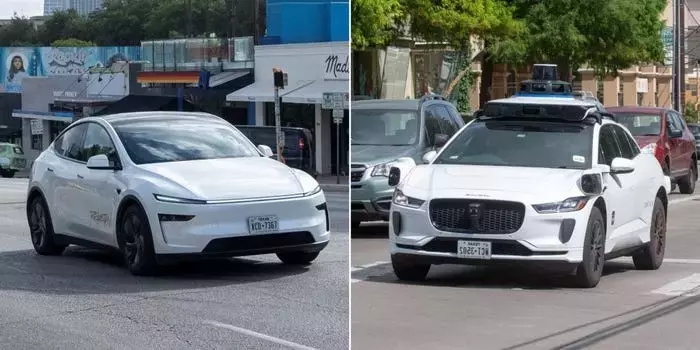
The burgeoning robotaxi industry is currently witnessing a fascinating competitive dynamic in Austin, Texas, where two prominent players, Waymo and Tesla, are actively vying for market presence. This unfolding scenario highlights both the rapid advancements and the inherent limitations within autonomous vehicle technology, particularly concerning their operational territories and public accessibility.
Autonomous Ambitions Collide in Austin's Expanding Robotaxi Landscape
In the vibrant city of Austin, Texas, a compelling rivalry is taking shape within the autonomous vehicle sector. On a recent Thursday, Waymo, a leader in self-driving technology, announced a substantial expansion of its robotaxi service area, nearly tripling its coverage from approximately 37 square miles to an impressive 90 square miles. This strategic move came mere days after Tesla, the electric vehicle giant, initiated a limited pilot program for its own robotaxi service in Austin. Tesla's debut garnered significant attention, not only for its entry into the market but also for the distinctive, somewhat unconventional, shape of its initial operational geofence.
Waymo, which has been providing autonomous rides to the general public in Austin for several months, extended its reach to encompass new vibrant neighborhoods such as Crestview, Windsor Park, Sunset Valley, and Franklin Park. This expansion aims to enhance the availability of fully autonomous transportation for more residents. However, despite this broader coverage, the service remains integrated with the Uber application, meaning users cannot directly request a robotaxi. Instead, the app intelligently determines whether to dispatch a human-driven vehicle or a Waymo, often prioritizing the most efficient route, which currently excludes freeway travel for public passengers. Waymo's spokesperson, Chris Bonelli, clarified that while their employees are already experiencing autonomous rides on freeways in San Francisco, Los Angeles, and Phoenix, this capability is not yet available to the general public in Austin. Tests conducted by Business Insider in downtown Austin revealed that journeys requiring highway access would typically default to a human Uber driver.
Conversely, Tesla's robotaxi offering in Austin is currently highly exclusive, accessible only to a select group of invitees. The company has not yet disclosed plans for when this service will open up to a wider audience or if additional robotaxis will be deployed. While Elon Musk, Tesla's CEO, has expressed ambitions for a swift scaling of the robotaxi service, specific timelines and operational details for broader public access remain unconfirmed.
Navigating the Future: Promises and Realities of Autonomous Mobility
As a keen observer of technological innovation and urban development, I find the ongoing competition between Waymo and Tesla in the Austin robotaxi market particularly illuminating. It underscores a critical phase in the evolution of autonomous mobility, characterized by both ambitious declarations and the pragmatic realities of implementation. While the expansion of service areas, such as Waymo's significant leap in Austin, represents a tangible step forward in making self-driving cars a part of daily life, it also highlights the persistent challenges. The current limitations, like Waymo's exclusion of public freeway travel and Tesla's highly restricted access, remind us that the fully realized vision of seamless, widespread robotaxi services is still some distance away. This period of incremental growth and cautious expansion, though perhaps frustrating for those eager for a driverless future, is essential for ensuring safety, refining technology, and building public trust. The ultimate winner in this contest may not be the company that covers the most ground fastest, but rather the one that most effectively balances technological prowess with practical, user-centric deployment and unwavering safety standards.